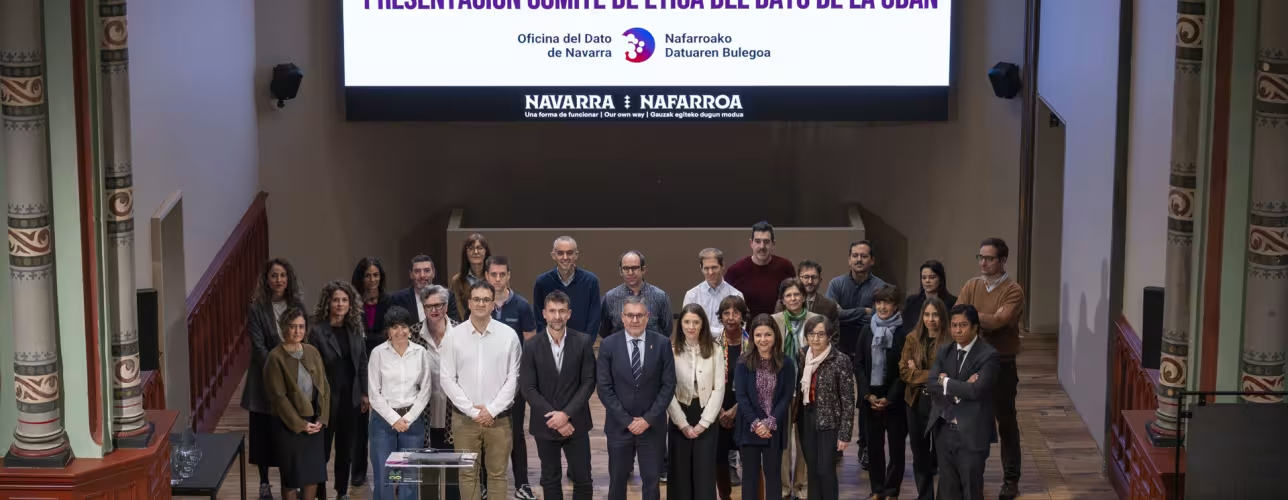
Twenty professionals appointed to the new Ethics Committee of the Navarra Data Office to promote responsible Artificial Intelligence
The 20 members of the Ethics Committee of the Navarra Data Office, the collegiate body that will ensure that the development and use of Artificial Intelligence (AI) within the public administration are carried out in a transparent and ethical manner, were presented this morning at an event held in the Salón Pinaquy at the headquarters of the Mancomunidad de la Comarca de Pamplona (MCP).
These professionals, with proven qualifications in technical, legal or humanistic fields, were proposed by various organisations, such as the Directorate General of Telecommunications and Digitalization of the Government of Navarra, the Public University of Navarra (UPNA), the University of Navarra, the Navarra Business Confederation (CEN), the ATANA technology and consultancy cluster, the Navarra Chamber of Commerce, the Committee of Representative Entities of Persons with Disabilities of Navarra (CERMIN), and Fundación Proyecto Hombre Navarra.
The Minister of University, Innovation and Digital Transformation, Juan Luis García, took part in the presentation and highlighted the importance of this new body as a key tool to guarantee a people‑centred digital transformation. “Today we are launching an Ethics Committee that we want to be much more than an administrative structure; its mission is to guarantee that technological progress and the use of data in our Administration are conducted ethically, fairly and transparently, placing the rights and well‑being of citizens at the centre of our decisions,” he noted. In his remarks, he also stressed that this commitment responds to a “crucial and complex” moment in which data have become “the great asset of our time,” making their responsible management a matter of “significant public relevance.”
In this regard, the minister further emphasised that “there is no digital transformation without digital ethics,” recalling that citizens’ trust in technology depends on responsible use. He underscored that the creation of this Committee “takes a further step in consolidating a data governance model that places Navarra at the forefront of digital ethics.” He also highlighted the particular importance of incorporating a gender perspective in data management, ensuring that “these assets only achieve their true value if they reflect the diversity of society as a whole.” For this reason, this Ethics Committee has been established “carefully balancing men and women” and committing to “address the gender perspective to eliminate biases and reduce existing inequalities.” “We want data ethics to also be a tool for equity,” he concluded.
The rest of the day included various informational talks explaining what the Ethics Committee is and recalling the content of the Data Ethics Manifesto. In addition, the ethics expert Pilar León, the legal expert María Jorqui and the expert in research, development and innovation in technologies, Leire Arbona, delivered presentations in their respective areas.
The event was closed by the Director General of Telecommunications and Digitalization, Josean Vizcay, who referred to the work carried out in this field since 2020, with the publication of the Data Ethics Manifesto. “This text placed ethics ahead of any data sharing initiative to safeguard the interests of citizens,” he recalled.
He also highlighted that the committee is “a space for interdisciplinary dialogue, where jurists, technicians, researchers and citizen representatives can reflect together on the impact of technology on our lives.” “This is how we ensure that Artificial Intelligence in Navarra has a human face and a social outlook,” he stressed.
Ethics Committee of the Navarra Data Office
The Ethics Committee of the Navarra Data Office is an advisory body that will act on matters related to the ethical implications of data management—both personal and public—as well as the use of Artificial Intelligence algorithms.
Among the functions of this committee are to preserve and promote the principles set out in the Ethical Manifesto on the Use of Data and Algorithms of the Government of Navarra; to advise the Coordination Commission and the Standing Committee of the Data Office on actions in which it is necessary to assess ethical aspects; to define protocols of action in situations involving ethical conflicts within the Office’s scope; to issue reports, proposals and recommendations on matters with ethical implications; and to advise on and make proposals aimed at fostering an ethical framework in the development of Strategic Plans, among others.
The members of the committee, presented today, will serve a four‑year term. At a subsequent constitutive session, the members will elect a chair. The body will hold regular meetings twice a year and may convene extraordinary sessions when deemed necessary.
Members of the Ethics Committee of the Navarra Data Office
The members are:
• Secretary: Jon Legarrea Oteiza (primary member); and Itziar Berrospe García (alternate).
• Members (Vocales):
With a communication profile
• Proposed by the Directorate General of Telecommunications and Digitalization: Jon Viedma Carrera (primary); and Javier Solano Marzo (alternate).
As experts in research, development and innovation in technologies related to Data Science:
• Proposed by the Directorate General of Telecommunications and Digitalization: Ángela Bernardini Gagliani, Mikel Galar Idoate and Iosu Rodriguez Alfaro (primary members); and, as alternates respectively, Gorka Garcia Rodero, Mª Teresa Mutilva Contreras and Juan Ardaiz Astrain.
• Proposed by the Public University of Navarra: José Javier Astrain Escola (primary) and Edurne Barrenechea Tartas (alternate).
• Proposed by the University of Navarra: Enrique Reina Martín (primary) and Patricia Muleiro Antón (alternate).
As legal experts in law applicable to technologies related to Data Science:
• Proposed by the Directorate General of Telecommunications and Digitalization: Itziar Alkorta Idiakez and María Ramírez de Arellano Alemán (primary); and, as alternates respectively, Juan Jesús Jaurrieta Galdiano and Nuria Esparza Pardo.
• Proposed by the Public University of Navarra: María Jorqui Azofra (primary) and Julen Llorens Espada (alternate).
• Proposed by the University of Navarra: Juan Carlos Hernández Peña (primary) and Mª Victoria Sánchez Pos (alternate).
As experts in applied ethics:
• Proposed by the Directorate General of Telecommunications and Digitalization: Iñigo de Miguel Beriain and Pilar León Sanz (primary); and, as alternates respectively, Naiara Carrasco García and Alberto Enrique Sánchez Gómez.
• Proposed by the Public University of Navarra: Francisco Idareta Goldaracena (primary) and Mª Jesús Rivera Escribano (alternate).
• Proposed by the University of Navarra: Belén Sádaba Díaz de Rada (primary) and Carmen Berasain Lasarte (alternate).
As experts in the management of technology companies:
• Proposed by CEN: Izaskun Gutiérrez Arruabarrena (primary) and Carlos Fernández Valdivielso (alternate).
• Through open procedure:
– Leire Arbona Puértolas (primary) and Eduardo Azanza Ladrón (alternate), proposed by ATANA.
– Fernando San Miguel Inza (primary) and Eva Fontecha Heras (alternate), proposed by the Official Chamber of Commerce, Industry and Services of Navarra.
As representatives of citizens, belonging to civic organisations or entities representative of social interests:
– María Aránzazu Garatea Elzaburu (primary) and José Antonio López Delgado (alternate), proposed by the Comité de Entidades Representantes de Personas con Discapacidad de Navarra – Desgaitasunaren bat duten Pertsonen Erakunde Ordezkarien Nafarroako Batzordea (CERMIN).
– Cristina Illescas Orduña (primary) and Pepa Palacio Rubio (alternate), proposed by Fundación Proyecto Hombre Navarra – Nafarroako Gizakia Helburu.
Source: navarra.es

