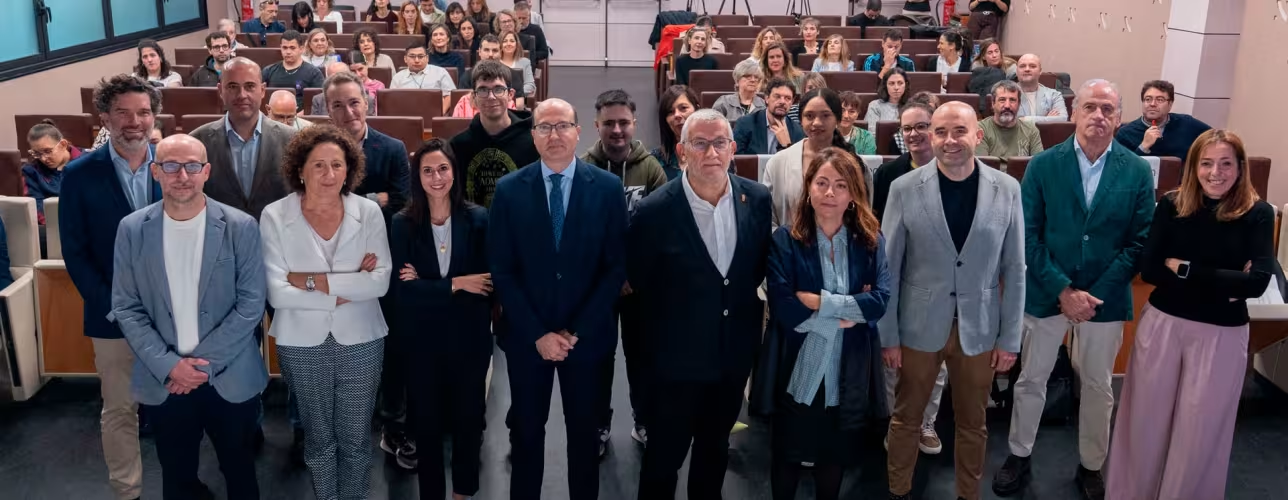
UMANA launches to promote the employment inclusion of people with intellectual disabilities in the tech sector
UMANA was officially presented today, a pioneering initiative aimed at promoting the creation of employment for people with intellectual disabilities in the technology sector.
The event, held in the assembly hall of the Navarra Business Confederation (CEN), was attended by the First Vice President and Minister of Presidency and Equality, Félix Taberna, who highlighted the project’s transformative nature: “Technology companies need people with diverse perspectives, capable of understanding and solving challenges from different angles. That is why it is so important for people with and without disabilities to work side by side. Innovation arises when people dare to ask new questions. And those questions emerge when diverse talents and complementary sensitivities interact.”
UMANA is structured as a social and technological innovation project whose goal is to establish a new model of employment integration for people with intellectual disabilities, facilitating their entry into the labour market in technological environments through Social Initiative Special Employment Centres.
The project is articulated around four main areas: job creation, through the engagement of companies committed to diversity, including the identification of positions and the adaptation of processes and tasks; training, through the technological adaptation of a training module accessible to people with intellectual disabilities; the development of training pathways, including the creation of materials and participatory training; and the design of a robust communication programme to support the expansion of the model, reaching a larger number of beneficiaries and participants.
The entire process is built from a human‑centred approach, where the individual is not a passive recipient but the protagonist and co‑creator of their own pathway. Each phase is designed so that beneficiaries can actively participate in the design, validation and improvement of solutions, making the project not only a route to employment but also an empowering personal experience.
Technological Sectors for Programme Implementation
Participants will carry out their work in Social Initiative Special Employment Centres, providing services in strategic sectors linked to technological transformation. Specifically, the project encompasses high‑growth areas such as artificial intelligence, data‑processing applications, predictive analysis, task automation, back‑office services and information processing using OCR technologies (Optical Character Recognition). The project also includes initiatives in process digitalisation, digital correspondence management and logistics associated with organisations’ digital transformation. Additionally, it includes participation in web development and digital accessibility projects.
Ultimately, these areas of work will enable participants to acquire cross‑cutting digital skills that support their active, qualified and productive integration into Navarra’s technological ecosystem.
These skills will be acquired through a training plan led by a top‑tier professional team from the El Molino Special Education School, working directly with Fundación TeReSA and the TASUBINSA Special Employment Centre.
Collaborative Governance and Project Budget
The UMANA project is structured through a collaborative governance model, in which Fundación TeReSA (Technology Research for Social Advance), as the main coordinator, leads the planning, implementation and monitoring of all actions, as well as communication with the various stakeholders. Fundación “La Caixa” finances the project, which has a total budget of 355,000 euros.
Meanwhile, the Directorate General of Planning, Coordination, Innovation and Evaluation of Public Policies of the Government of Navarra, through the VidAAs Center, managed by the public company Nasertic, provides technical and operational support, with a special focus on research, piloting and validation actions, ensuring alignment with social innovation public policies. Fundación hiberus, which connects people and technology to build a better future, ensures that the technological aspect of the project meets the required quality and coherence to achieve its goals.
Event Development
The Secretary General of the Navarra Business Confederation (CEN), Carlos Fernández Valdivielso, opened the event by highlighting CEN’s commitment to inclusive employment and digital transformation.
Next, Vice President Taberna underscored the emancipatory value of work and its role in building a fairer society: “The labour movement taught us something that still holds true: work is not only a way to earn a living; it is also dignity, pride and belonging. But for people with disabilities, accessing a job means even more: it means breaking stereotypes, overcoming barriers and demonstrating that employment inclusion is one of the most effective paths toward a truly equal society.”
Two round tables followed. The first, titled “Talent Without Limits: Breaking Digital Barriers,” featured Natalia Galbán and Iñigo Galbete from the El Molino Special Education School; Fernando Laguna, Director of Services at Tasubinsa; and Rubén Fonseca and Ana Rosa Mejía, also from Tasubinsa. The session was moderated by Paula Estrada, Director of Fundación TeReSA.
The second round table, moderated by Idoia Urmeneta, Coordinator of the VidAAs Center, included Paula Estrada; Txerra García de Eulate, Director General of Planning, Coordination, Innovation and Evaluation of Public Policies; Javier Lagunas, Managing Director of Tasubinsa; Esteban Morrás, trustee of the Fundación Ciganda Ferrer; and Sandra Parrilla, Director of Fundación hiberus.
Finally, the representative of Fundación “La Caixa” in Navarra, Izaskun Azcona, closed the event, emphasising that “differences enrich us, nourish us and help us become better.”
Social and Labour Diagnosis
Navarra has 36,317 people with officially recognised disabilities. Of these, nearly 18,000 are of working age (between 18 and 64), but only 38% participate the labour market, according to the latest study by the National Statistics Institute (INE).
Furthermore, data collected by COCEMFE (Spanish Confederation of People with Physical and Organic Disabilities) in Navarra show that 47% of employment contracts signed in 2024 with people with physical or organic disabilities were temporary—practically double the rate among the population without disabilities—highlighting the need to continue promoting inclusive and quality employment.
For people with intellectual disabilities, the challenge is even greater: only 2.4% are employed. This low employment rate is largely due to the lack of adapted technological training and the limited awareness within companies of the capabilities of this group, underscoring the need to adapt processes and workplace environments.
With the support of projects like UMANA, Navarra has the opportunity to establish itself as a benchmark in inclusive innovation: a region where technology and training are placed at the service of equal opportunities and the full development of everyone’s human potential.
Source: navarra.es


