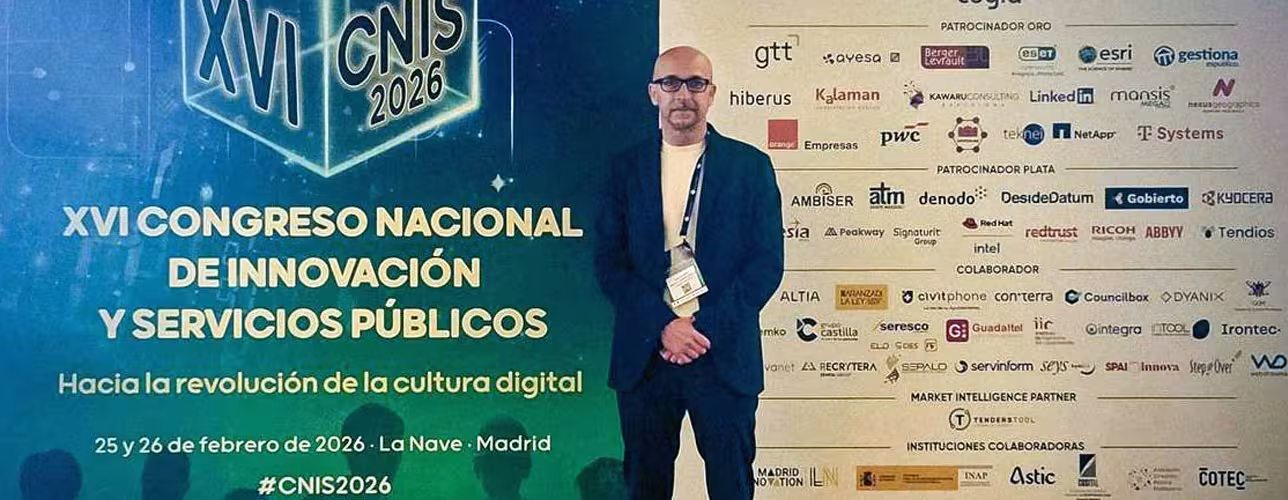
A Government of Navarre project to drive social improvements with Artificial Intelligence, finalist at the National Congress on Innovation and Public Services
VidAAS is a pioneering innovation center specializing in new longevity and autonomous living. It is attached to the Directorate-General for Public Policy Planning, Coordination, Innovation and Evaluation, within the Department of Presidency and Equality of the Government of Navarre, and is managed by the public company NASERTIC. Launched in October 2024, the center makes nearly 1,000 square meters available to social entities, companies, universities, and technology centers to experiment with and test new products or services in situ aimed at improving people’s autonomy and quality of life.
The CNIS Awards, for their part, honor each year the best initiatives in innovation and digital transformation within Spain’s public administrations, highlighting projects that improve public services and generate real impact for citizens. In this edition, which received 226 submissions, the awards are considered the leading recognitions of public-sector transformation in Spain. The awards ceremony held this week featured 30 finalists across 11 categories. The Director-General for Public Policy Planning, Coordination, Innovation and Evaluation, Txerra García de Eulate, attended on behalf of the Regional Government.
The “Retos IA” project, selected as a finalist, was developed last year with the goal of identifying concrete needs in the public and social spheres and addressing them through Artificial Intelligence–based solutions, using an ethical, inclusive, and human‑centered approach.
The various phases of the project involved nearly 200 people from around twenty entities. During the seven‑month initial phase, 75 key needs were identified and more than 130 proposals were generated through intensive collaborative dynamics such as Discovery Sprints, Hackathons, and Matchathons. These proposals were then narrowed down and prioritized into three main challenges: accessible and inclusive public transport, universal access to information and digital procedures, and accessible wayfinding in buildings and complex spaces.
Improving decision‑making, service efficiency, and citizen support
Through this initiative, the VidAAS Center has applied a model for detecting and defining real challenges linked to public policies and social needs, aimed at designing and validating AI‑based prototypes and solutions with the purpose of improving decision‑making, service efficiency, and citizen assistance.
The “Retos IA” initiative emerged as a natural and replicable evolution of the success and experience gained from the earlier “Retos” project, promoted by the Government of Navarre in collaboration with the Social Reality Observatory—part of the Department of Social Rights, Social Economy and Employment—and the Department of University, Innovation and Digital Transformation.
The initiative has been grounded in collaboration between the Administration, technology companies, the innovation ecosystem, and social stakeholders, fostering a model of public‑private open innovation. Among the participating entities are the NAIR Center for Artificial Intelligence Research and the ATANA Association of Technology and Consulting Companies. The project is also based on criteria of transparency, data governance, and responsible use of artificial intelligence, aligned with public values and committed to reducing digital divides.
The “Retos IA” project has consolidated the VidAAS Center as a space for experimentation and knowledge transfer, where technology is placed at the service of people and of a more effective, closer, and evidence‑based public administration.
Source: navarra.es


