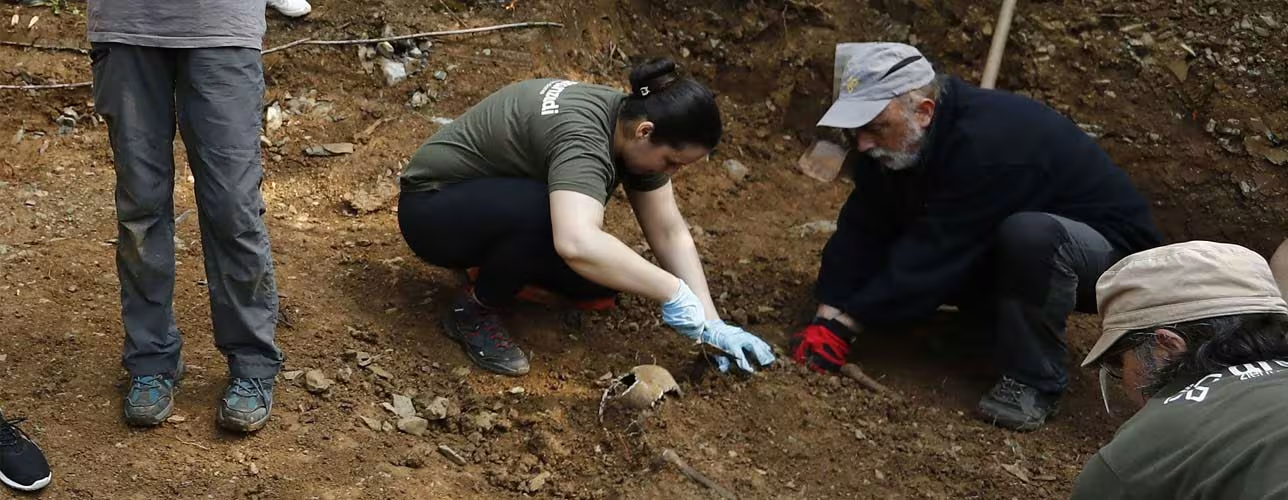
The Navarre Institute of Memory, in collaboration with the Government of Navarre’s DNA Bank, identifies Jesús Esteban Muñoz and Gerardo Gómez Lorenzo, murdered in 1938.
The Department of Memory and Coexistence, External Action and Basque of the Government of Navarre, through the Navarre Institute of Memory and in collaboration with the Government’s DNA Bank and the genetic laboratory managed by the public company Nasertic, has succeeded in identifying the mortal remains of two prisoners from Fort San Cristóbal who took part in the major escape of May 22, 1938 and were captured near the border with France. They are Jesús Esteban Muñoz, from Segovia, and Gerardo Gómez Lorenzo, from Galicia, both murdered in Esteribar.
The first identification corresponds to the prisoner Jesús Esteban Muñoz, born on June 22, 1906, in Villaverde de Íscar (Segovia) and a resident of Portillo (Valladolid). Esteban was tried and sentenced to 20 years in prison by a court martial held in Valladolid on November 20, 1936, accused of aiding the rebellion. He entered the fort on Mount Ezkaba on January 20, 1937, where he remained until the day of the escape. As explained in the Navarre Institute of Memory publication Lur Azpian – Bajo Tierra. Exhumaciones en Navarra, 1939–2025, three detainees were captured in Eugi and two others in the Bardegi area, between Usetxi and the Egozkue pass. After being killed, they were taken to the cemetery in Urtasun, where they were buried in a mass grave. In May 2017, the exhumation of the four bodies buried in that grave was carried out, and the identification of Andrés Zudaire, a resident of Azagra—whose family had previously exhumed his remains in 1978—was confirmed. On this occasion, thanks to genetic samples provided by suitable family donors, it has been possible to identify Jesús Esteban. Recently, a relative contacted the Navarre Institute of Memory to inquire about his whereabouts.
The second identification corresponds to the Galician prisoner Gerardo Gómez Lorenzo, born and living in Bergondo (A Coruña) on September 24, 1916, single and a carpenter by profession. Gómez was tried by court martial on January 29, 1937, in A Coruña and sentenced to 30 years in prison for aiding the rebellion. He entered the prison at Fort San Cristóbal on June 14, 1937, where he remained until the escape. On May 24, 1938, two escaped prisoners were captured and held in the school in the village of Leranotz (Esteribar). After being confessed by the parish priest of Agorreta, they were taken to the Oiazki area, where they were killed and buried. His body was exhumed in May 2018. Researcher Fermín Ezkieta contacted his relatives in Bergondo and in Azul (Argentina), which made it possible to compare their genetic samples with the remains of escaped prisoners that had not yet been identified.
It should be recalled that on May 22, 1938, 795 prisoners took part in the escape from Fort San Cristóbal, of whom 207 were killed in various locations, almost always after being recaptured. At least 54 bodies of these escapees have been recovered, and 12 have been genetically identified.
50 identifications in ten years of the DNA Bank
It is now ten years since the creation of the Government of Navarre’s DNA Bank, in application of Article 8 of Regional Law 33/2013, on the recognition and moral reparation of Navarrese citizens killed and victims of repression following the 1936 military coup. Since then, 439 cases have been opened for the collection of genetic samples from relatives to compare with human remains recovered through the Government of Navarre’s Exhumation Program, totaling 163 remains since late 2015. This has made it possible to reach 50 identifications, representing 31% of the total—a significant percentage compared with figures in other regions.
The Navarre Institute of Memory continues its work, with the help of memorial associations and researchers, in locating new graves (recent surveys have been carried out in Larraya, Cendea de Cizur, and in Vidaurre, Guesálaz) and in finding relatives of victims, a complex process due to their wide geographical dispersion. These latest identifications have been possible thanks to genetic samples from relatives received recently. At the same time, the Nasertic laboratory continues to work on more precise identification systems to expand these results. For all these reasons, the Navarre Institute of Memory once again reminds that anyone who can provide information on the location of graves or on contacting relatives can do so via the email address inm@navarra.es.
Source: navarra.es


