Navarra accelerates its progress in the synthetic biology race
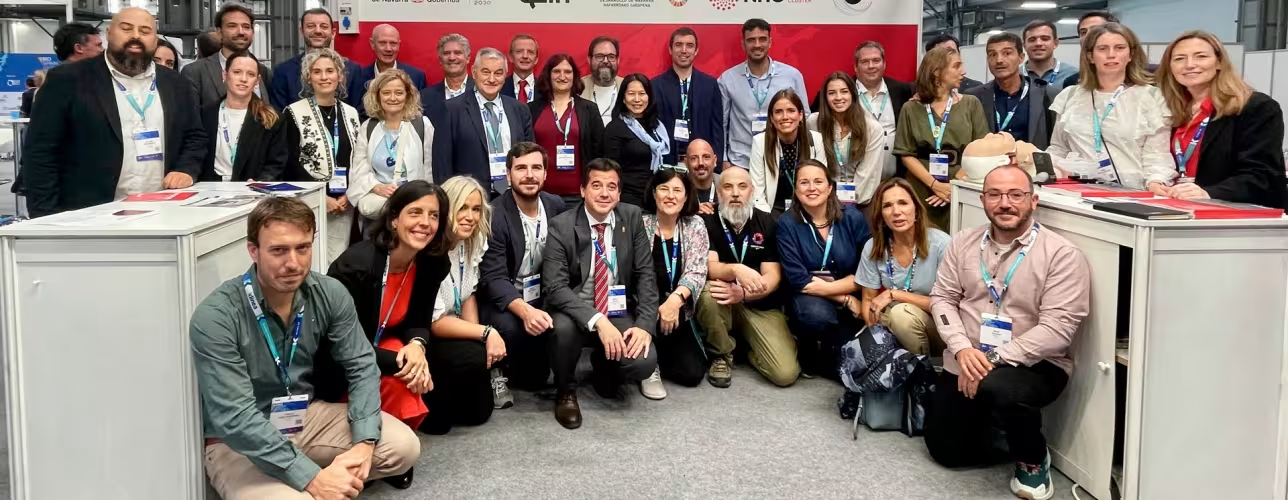
The Councillor for Industry and Ecological and Business Digital Transition, Mikel Irujo Amezaga, and the Director General for Energy Transition and Digital Transition, Business R&D&I and Entrepreneurship, Garbiñe Basterra, presented Navarra as the gateway to European synthetic biology at BioSpain 2025, the international fair currently being held in Barcelona. Representing Navarra at the event were ten companies, ten startups and representatives from the public entities CEIN, Sodena, the IRIS Navarra Innovation Hub and the Navarra Health Cluster.
With the upcoming implementation of the Synthetic Biology Business Development Plan BioSintNA for Navarra, the Comunidad Foral aims to consolidate itself as an international benchmark in the bioeconomy and as a competitive synthetic biology hub. Councillor Irujo highlighted several indicators that position Navarra as a leading region in the health sector, noting that “it has 31,500 jobs in total, and the private sector generates more than 3€ billion in revenue, both within Navarra and elsewhere. This sector represents 17.1% of patents and shows very high specialisation in biotechnology and pharmaceutical products.” In this context, he stressed that “Navarra offers a rich biotechnology and synthetic biology ecosystem, with strong presence in the health, agri-food and renewable energy sectors, with more than 1,800 related jobs.” According to the councillor, programmes supporting the creation and strengthening of innovative technology-based companies, combined with incentives and tax deductions and support for strategic R&D projects, help “position our region as one of the leading territories in synthetic biology, driving an innovative, sustainable and collaborative business ecosystem that promotes the development of the bioeconomy, scientific progress and improved quality of life.”
Navarra’s business ecosystem is further strengthened by the work being carried out to create a Synthetic Biology Chair at the Public University of Navarra (UPNA); by CEIN’s work to identify and plan entrepreneurship actions related to synthetic biology; by the applied medical research carried out by CIMA and the University of Navarra; by the IRIS Innovation Hub to define the laboratory’s usage model; by the Navarra Health Cluster; and by the development agency Sodena and its Invest in Navarra division, which support projects financially at different development stages, identify opportunities abroad and attract investment linked to synthetic biology and other strategic areas.
For her part, Director General Garbiñe Basterra highlighted the tools Navarra has to become a reference in biotechnology research and project development. She stated that “from 2019 to the 2025 call that has just been resolved, a total of 13 projects in the field of biotechnology have received subsidies amounting to 14.34 million euros.” According to Basterra, these projects were developed thanks to consortia formed by Navarra’s technology and research centres, in collaboration with universities and companies, thus promoting public-private partnership as the backbone of development.
Cutting-edge infrastructures for biotechnology and synthetic biology
Garbiñe Basterra also highlighted the state-of-the-art equipment hosted at the IRIS Navarra Innovation Hub, located in the El Sario building of UPNA. With an investment of 5 million euros, the Synthetic Biology Laboratory offers the full research workflow: from gene synthesis and protein production to functional analysis and molecular characterisation. “This facility offers companies and institutions cutting-edge infrastructures for biotechnology and synthetic biology, providing the ecosystem with extensive technological capabilities,” she explained.
Around ten Navarrese biotech startups are present at this internationally renowned event. Several of these companies take part in the HEALTH ScaleUp programme for scaling up emerging health sector companies, run by the public enterprise CEIN, which is now in its fifth edition.
Specifically, the firms Allbiotech, Betternostic, Ingredalia, Microneox, Nanogrow Biotech, Nucaps Nanotechnology, Opportunity Health, Telum Therapeutics, Thodo and Trimerbody Pharma have been able to showcase their products and services and engage with potential clients, investors and partners.
Additionally, the CEIN team held meetings with stakeholders of the biotechnology ecosystem—both national and international—to explore possible collaborations and presented the specialised services it offers for the development of the biotech sector, which cover everything from identifying new ideas to launching and scaling startups. Sodena, for its part, strengthened ties with venture capital firms in the sector through visits to the Parc de Recerca Biomèdica, participation in a lunch organised by Invest in Spain and attendance at the official welcome event for sponsoring and investing organisations.
Navarra’s business ecosystem is complemented by the presence of other companies such as Bionanoplus, Genbioma, InnoUp, Medibiofarma, MOA foodtech, Palobiofarma, Cocuus, LEV2050, Laboratorios Ojer Pharma and 3PBIOVIAN.
Round table with Navarrese participation
The official programme of BioSpain 2025 included a round table featuring featuring Navarrese participation and moderated by Fran Antequera (ATG SynBio Spain and AgroTech Mission Centre of Andalucía). The session included contributions from startup representatives, researchers and innovation and investment leaders working in the field. Participating speakers included Ana Ceniceros, R&D Manager at LEV2050; Gonzalo R. Ordóñez, Director of Personalised Medicine and Laboratories at Nasertic; Nicolás Galmarini, CEO of Nanogrow; and Luis Pareras, founder and managing partner of Invivo Partners, who highlighted the importance of consolidating infrastructures, fostering entrepreneurship, promoting industrial development and providing financial support to position Navarra and Spain competitively in this emerging sector.
The panel also included international references, such as the insights shared by Paul Freemont, Head of the Section of Structural and Synthetic Biology at Imperial College London.
Source: navarra.es


