Navarra strengthens its leadership in biotechnology and technology transfer at the European Transfiere forum
a { text-decoration: none; color: #464feb; } tr th, tr td { border: 1px solid #e6e6e6; } tr th { background-color: #f5f5f5; }
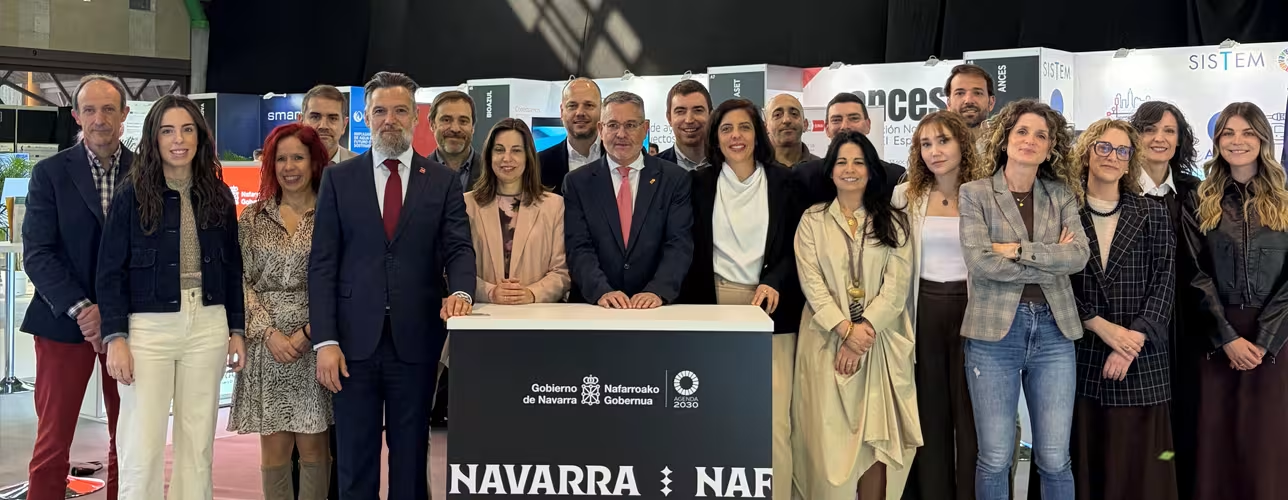
Navarra showcased at Transfiere, the European Forum for Science, Technology and Innovation, its strategy to consolidate a solid biotechnology ecosystem that connects science, business and public policy. The delegation, led by the Councillor for University, Innovation and Digital Transformation, Juan Luis García, took part in two round‑table discussions at the event and had its own stand.
In the first session, which brought together members of the Ministry of Science, Innovation and Universities with representatives from the governments of Navarra, Aragón, Castilla y León and Castilla‑La Mancha to discuss the Complementary Plan for Knowledge Transfer, Councillor García stressed that “the real challenge is not only producing excellent science, but ensuring that this knowledge becomes tangible innovation.”
“The key question is not only how much knowledge we generate, but how much of that knowledge is transformed into real value for society. We do not always progress at the same pace in generation and in transfer. And that is where we must act with greater determination,” he added, recalling that the new Navarra Science, Technology and Innovation Plan 2026–2030 includes a specific focus on transfer.
“We want to strengthen the mechanisms that connect research with the business sector, facilitate public‑private collaboration, and better support the path from idea to market, ensuring that as much knowledge as possible becomes real innovation—and that this real innovation acts as a driver for territorial development,” he underlined.
A dedicated round table on Navarra was later held, focusing on the role of transfer, scientific infrastructures and talent in the development of the sector. It brought together institutional, business and technical representatives to analyse how to strengthen the connection between scientific knowledge and the market.
During the discussion, it was highlighted that the biotechnology field is undergoing strong global growth, with a market expanding at a rate of 17.3% annually. In Spain, biotech activity already moves 700 million euros, contributes 0.1% of GDP, employs more than 10,000 people, and represents 4% of global scientific output in the field.
In this context, Navarra stands out for having one of the most dynamic ecosystems: more than 30 biotechnology companies, seven knowledge‑generating agents, advanced scientific infrastructures, and 1,800 people working directly in the sector. According to the AseBio report, the region has the highest concentration of biotechnology companies in Spain, with 1.16 companies per 1,000 inhabitants.
This potential is supported by the Navarra R&D&I System (SINAI), made up of 45 entities, 23 of which are dedicated to generating R&D&I, including universities, research centres, technology centres and business units. In total, nearly 4,000 people are currently conducting research in Navarra.
Ecosystem, transfer and infrastructures
In her remarks, the Director‑General of Science, Technology and Innovation, Agurtzane Martínez, highlighted the importance of continuing to reinforce the mechanisms that enable the knowledge generated within SINAI to be transformed into real transfer to companies and society. She also emphasised the strategic commitment expressed in the Science and Technology Plan to areas such as synthetic biology, bioinformatics and personalised medicine.
For her part, the Managing Director of CEIN, Uxue Itoiz, underlined the role of deep‑tech entrepreneurship and the need to foster an environment that supports the scaling of technological projects from the laboratory to the market.
From the business perspective, Ingredientalia’s CEO, Miguel Ángel Cubero, explained how biotechnology makes it possible to transform agri‑food by‑products into high added‑value functional ingredients, illustrating the real impact of technology transfer.
Likewise, Gonzalo Rodríguez, Head of the Personalised Medicine and Laboratories area at NASERTIC, highlighted the value of the IRIS Digital Innovation Hub as a strategic infrastructure that covers different stages of the value chain, enabling the development and industrial application of biotechnological technologies.
A stand showcasing the strength of Navarra’s ecosystem
Navarra participated in the Transfiere forum with its own stand, financed and led by the Department of University, Innovation and Digital Transformation of the Government of Navarra. The public company CEIN and ADItech, coordinator of SINAI, also contributed to its organisation. The delegation included representatives from IRIS Navarra, the Digital Innovation Hub; Transfer UNAV, the Technology Transfer Office of the University of Navarra; the Public University of Navarra (UPNA); and NAIR Center, the Artificial Intelligence Research Centre of Navarra. In addition, CEIN‑mentored startups—bitmatrÍA and Ingredalia—were also present in the Navarra space.
Participation in this fair is part of the Government of Navarra’s strategy to strengthen the visibility of the region’s R&D&I ecosystem, reinforce national and international alliances, and position the region as a European benchmark in biotechnology, innovation and transfer.
Source: navarra.es


