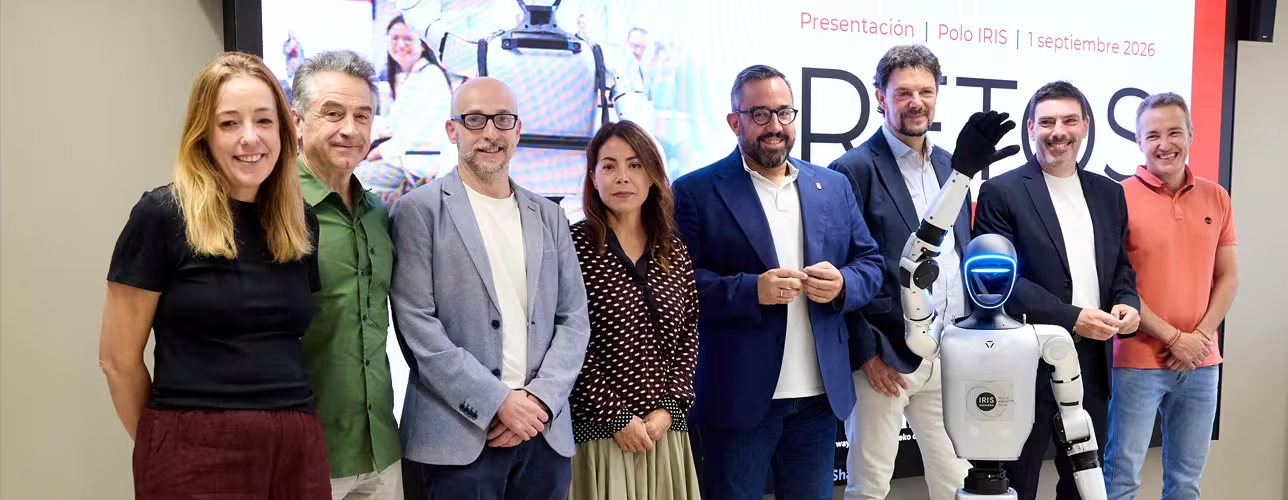
Navarre launches ‘Robotics Challenges’ to develop technological solutions that improve the autonomy and quality of life of older people with disabilities
The Government of Navarre and ADACEN today presented ‘Retos Robótica’ (Robotics Challenges), a new social and technological innovation project aimed at identifying the real needs of older people with disabilities and exploring the potential of robotics to provide solutions that help improve their autonomy and quality of life. The initiative is funded by Fundación “la Caixa” and is supported by the Navarre Artificial Intelligence Research Center (NAIR Center) and the VidAAs Center.
The presentation, held in the training room of the IRIS Hub, was attended by the First Vice President, Minister of the Presidency and Equality, and Spokesperson of the Government of Navarre, Javier Remírez; the Managing Director of ADACEN, Andrés Ilundain; and Fundación “la Caixa”’s Delegate in Navarre, Izaskun Azcona.
‘Retos Robótica’ proposes a people-centered innovation process that will begin by identifying real needs and challenges, incorporating both the current experiences of older people with disabilities and a forward-looking perspective from middle-aged people with disabilities. Families, professionals, specialists, and organizations from the technological ecosystem will also participate in the different phases of the programme.
The objective is to connect these needs with existing capabilities in the field of robotics in order to design, test and develop solutions that can provide distinctive value in real-life situations.
During his speech, First Vice President Javier Remírez highlighted that ‘Retos Robótica’ reflects the Government of Navarre’s commitment to technological transformation that is “people-centered and geared towards generating social progress.”
“Technology must be at the service of people. We should not only ask what it is capable of doing, but also what people need and how we can use our technological capabilities to respond to those needs,” he stated.
Remírez placed ‘Retos Robótica’ within a line of work that the regional government has been developing to connect technological innovation, social innovation, and public policies, and recalled previous initiatives such as Retos IA and the UMANA project.
“Thanks to projects like this, we have been able to confirm something that we now want to bring into the field of robotics: innovation works better when it starts with a challenge rather than with a technology,” the Vice President noted.
The Vice President also highlighted the collaboration between public administrations, social organizations, and technology stakeholders that characterizes the project. “We want an Administration that does not innovate alone, and an innovation model that connects the public sector with social organizations, companies, technology centers and, above all, with people,” he explained.
People at the heart of the process
For his part, ADACEN Managing Director Andrés Ilundain emphasized the value of a model in which people participate from the outset in identifying challenges and later in designing and validating potential solutions.
“We do not want to develop a technology first and then look for where to apply it. We are going to do exactly the opposite: first, we are going to listen,” he explained.
The project will work from two complementary perspectives. On the one hand, it will gather the current experiences of older people with disabilities and, on the other, it will incorporate a forward-looking perspective through middle-aged people with disabilities, with the aim of identifying needs that may emerge as they progress through the ageing process. Families, professionals, and organizations will also contribute their knowledge of everyday situations and needs that could benefit from robotics-based solutions.
Ilundain highlighted that this methodology makes it possible to move beyond a model in which people are merely recipients of technological solutions and instead positions them as active agents of innovation. “It is not about adapting people to technology, but about ensuring that technology adapts to people,” he stated.
The ADACEN Managing Director also stressed that the project seeks to analyse the possibilities of robotics in a realistic way. “Our goal is not to demonstrate that a robot can do everything, but to discover what it can genuinely do well and where it can provide distinctive value to people,” he said.
From real needs to prototype development
‘Retos Robótica’ will be implemented through four successive phases, enabling progress from the initial identification of needs to the development and demonstration of prototypes.
Phase 0 will consist of an event at the Hub, organized by NAIR Center, aimed at exploring how robotic solutions can improve everyday life. It will take place on 16 September, and the following day a technological showroom will be held at the VidAAs Center for social organizations, companies, public administrations, students, and researchers.
The first phase will be a Discovery Sprint focused on identifying the real needs and challenges of older people and incorporating both their current experiences and the forward-looking perspective of middle-aged people with disabilities.
This will be followed by a Co-Design Hackathon, in which users, families, professionals, citizens, innovation and robotics specialists, and multidisciplinary teams will work together to transform the selected challenges into robotic solution concepts.
The proposals will then move on to a Testing and Use Scenario Laboratory, where aspects such as usefulness and acceptability, technical feasibility, accessibility and safety, ethical risks, sustainability, and real-world implementation conditions will be analysed.
This process will make it possible to select and refine the challenge with the greatest potential, establish its use scenario, and define the requirements that the solution must meet.
The final phase will be a Development and Prototyping Hackathon aimed at developing and demonstrating prototypes capable of addressing the selected challenge. The proposals will ultimately be evaluated, and the highest-rated solutions will receive awards.
The programme is therefore intended to complete a full pathway that begins with needs expressed by people themselves and concludes with tangible solutions: needs, prioritized challenges, robotic solution concepts, use scenarios, and demonstrated and evaluated prototypes.
For her part, Fundación “la Caixa”’s Delegate in Navarre, Izaskun Azcona, explained that the organization decided to support ‘Retos Robótica’ because of its ability to connect technological innovation with social impact.
“Innovation and technology reach their full potential when they contribute to improving people’s lives. Behind this project there is not only technology: there are older people, people with disabilities, families, professionals, and real needs that we want to try to address,” she emphasized.
“Technological transformation must leave no one behind, but we can go even one step further: it is not only about ensuring that everyone can participate in that transformation, but also that they can take part in its design,” she stated. “The success of social innovation cannot be measured solely by the sophistication of the technology we are capable of developing. We must measure it by the autonomy we can foster, the barriers we can remove, the opportunities we can create, and the improvements we can bring about in people’s daily lives,” she added.
A social and technological innovation ecosystem
‘Retos Robótica’ builds on a collaboration strategy between the Government of Navarre, social organizations, and the regional technology and innovation ecosystem, with the aim of experimenting with new technologies from a people-centered perspective.
Within this model, ADACEN contributes its experience and direct knowledge of the needs of people with disabilities, older people, families, and professionals; NAIR Center contributes its capabilities and specialized expertise in robotics; and the VidAAs Center, promoted by the Directorate-General for Planning, Coordination, Innovation and Evaluation of Public Policies and managed by the public company NASERTIC, serves as a space for social innovation and for connecting social needs, public policies, and technological capabilities.
Finally, the development and facilitation of this process will be carried out by Beesy, a consultancy firm that will support participating organizations throughout the different phases envisaged in the project.
Source: navarra.es


