Navarre promotes the first public laboratory in Bardenas to test solutions that improve rural environment management
a { text-decoration: none; color: #464feb; } tr th, tr td { border: 1px solid #e6e6e6; } tr th { background-color: #f5f5f5; }
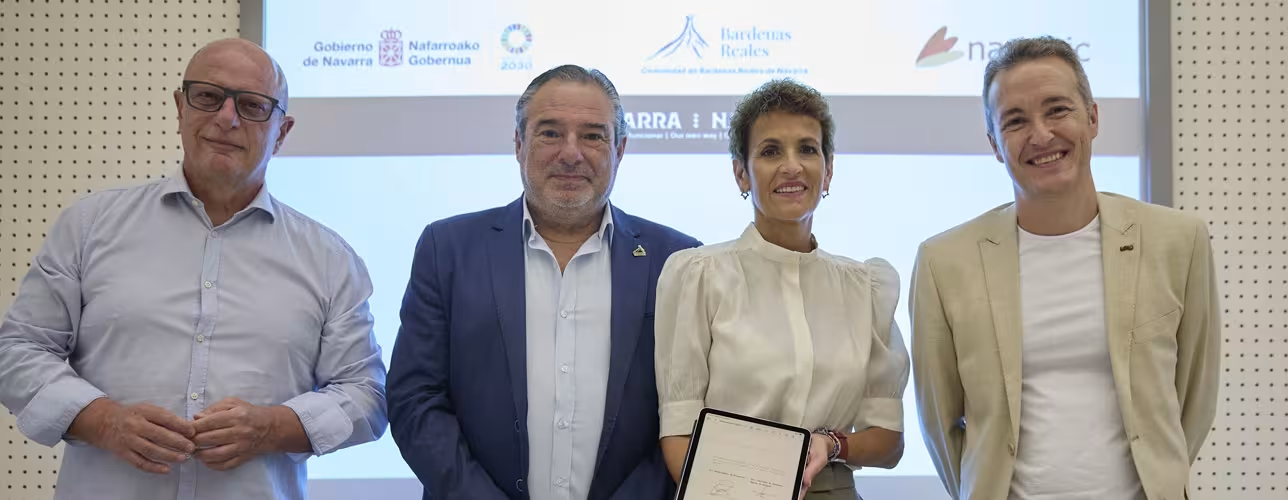
Navarre President María Chivite Navascués took part this Thursday in the signing of the agreement to create the first public innovation laboratory in the Chartered Community, which will make it possible to test technological solutions under real-world conditions aimed at improving knowledge and protection of the natural environment, enhancing its management, and creating new opportunities for education, research, and development in the Ribera region.
During the event, the Minister of Education, Carlos Gimeno; the President of the Bardenas Reales Community, José María Agramonte; and the Managing Director of the public company NASERTIC, Luis Campos, signed the agreement that will enable the launch of this initiative, the first public IoT Living Lab in the Chartered Community.
Following the signing, President Chivite highlighted that “the project reflects a vision of innovation that serves both people and the territory” and emphasized the importance of choosing the Ribera region as the location for this initiative.
“We want innovation to reach every part of the territory and translate into tangible opportunities. This project shows that technology is a great ally in better protecting our natural heritage, generating knowledge, and providing new opportunities for education and development from within the Ribera itself,” she added.
Open Innovation Laboratory
A Living Lab, or open innovation laboratory, is a space where public administrations, educational institutions, companies, and researchers work together to find solutions to real-world needs. In this specific case, Bardenas Reales will become an environment for developing and testing tools that can help, for example, improve understanding of the state of the natural environment, protect biodiversity, enhance agricultural and livestock activities, prevent incidents, and advance climate change adaptation.
In addition, the project will enable students from ETI Central Integrated Polytechnic Centre in Tudela to develop projects related to the Smart Manufacturing and Internet of Things specialization in a real-world environment, thereby strengthening their practical learning and their connection with Navarra’s business and technology ecosystem.
To make this possible, a communications network will be installed throughout the Natural Park and Biosphere Reserve, enabling small sensors distributed across the territory to be connected. These devices will be able to collect and transmit environmental data, improving understanding of what is happening in the area and supporting decision-making.
The network will use LoRaWAN technology, a wireless communication system designed to connect low-power sensors over long distances, making it particularly suitable for extensive natural areas such as Bardenas Reales.
Collaboration with the Education System
President Chivite also highlighted collaboration among institutions, the education system, companies, and researchers as one of the project’s main strengths. “We are bringing together technology, knowledge, vocational training, and sustainability to address real needs. Innovation means using new technologies to solve problems, improve our environment, and, of course, create opportunities,” she stated.
In this regard, the President placed particular emphasis on the role of vocational education and training. This project will allow students and teachers from ETI Central Integrated Polytechnic Centre in Tudela to develop and test solutions in a real-world environment and apply the knowledge acquired during their training.
“Vocational education and training needs settings where students can learn by solving real challenges. This Living Lab will enable students and teachers to develop technological solutions with direct applications in a unique natural environment, strengthening their skills and fostering connections between educational institutions, businesses, and innovation,” added President Chivite.
For his part, the President of the Bardenas Reales Community of Navarre, José María Agramonte, stated that the Community of Bardenas Reales remains committed to collaboration with the Government of Navarre and its various departments in order to continue incorporating technical improvements for the benefit of citizens and the territory. He noted that this commitment is pursued while respecting and protecting traditional land uses and the many environmental protection designations of Bardenas, with the additional objective of creating new opportunities and helping to combat depopulation in the area whenever possible.
A Partnership for Research, Education, and Innovation
The agreement establishes a stable framework for collaboration between the Government of Navarre, the public company NASERTIC, and the Community of Bardenas Reales to develop shared infrastructure that supports applied research projects, technological innovation, and improved management of the natural park.
NASERTIC will be responsible for the design, deployment, operation, and maintenance of the technological infrastructure, while the Community of Bardenas Reales will provide the spaces and authorizations required for its implementation.
The Department of Education will, in turn, promote the participation of teachers and students from ETI Central Integrated Polytechnic Centre in Tudela in the development and validation of the various projects carried out within this open innovation environment.
Strategic Commitment to Innovation and Territorial Cohesion
Through this agreement, the Government of Navarre reinforces its commitment to innovation that is closely connected to territorial needs and capable of generating knowledge, attracting talent, and creating opportunities across all regions of the Chartered Community.
The selection of the Ribera region and Bardenas Reales as the setting for this project reflects a commitment to fostering an ecosystem that combines technological innovation, sustainability, and territorial development, positioning the area as a benchmark for future research and experimentation initiatives.
The agreement will initially run for four years, with the possibility of a four-year extension, and will help consolidate a model of institutional collaboration based on sharing infrastructure, knowledge, and resources to develop high value-added projects in one of Navarre’s most iconic natural areas.
Source: navarra.es


