Remains of Luis García Lago identified in Etulain, 88 years after his killing following the escape from San Cristóbal Fort
The Department of Memory and Coexistence, External Action and Basque, through the work carried out by the Institute of Memory, the DNA Bank of the Government of Navarre, and the technical efforts of the public company Nasertic, has succeeded in identifying the remains of Luis García Lago, born on July 15, 1915, in Vigo and a resident of Teis (Pontevedra).
Luis García Lago, a day laborer and single, was arrested in the summer of 1936, accused of military rebellion, and sentenced to life imprisonment in a court-martial held in Vigo on September 16, 1936. He arrived at the San Cristóbal Fort on Mount Ezkaba on February 22, 1937, and took part in the mass escape of May 22, 1938—now exactly 88 years ago.
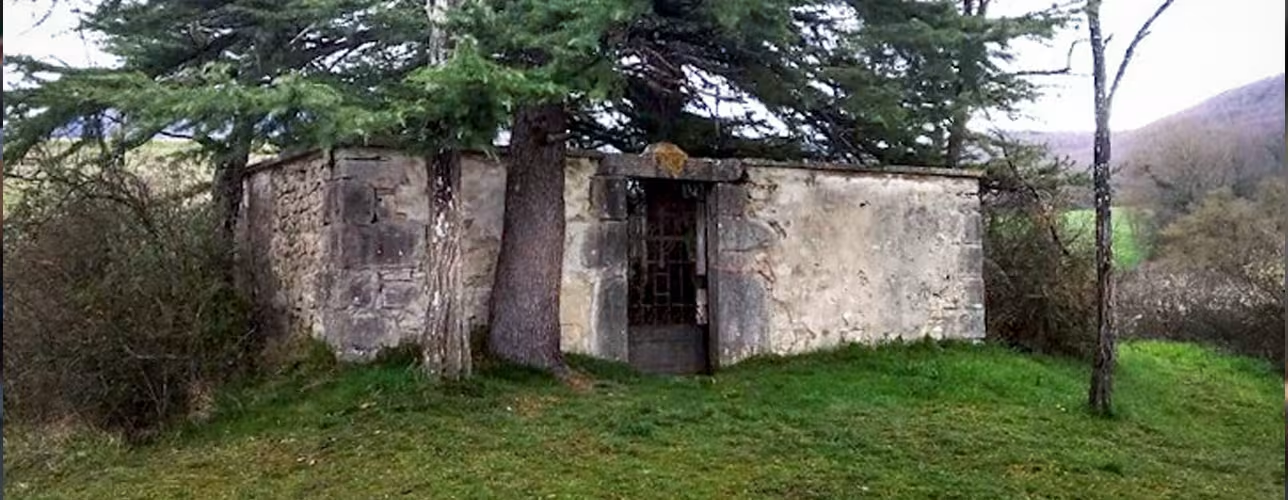
The identification of García Lago was made possible by comparing genetic samples provided by his relatives, who were located thanks to the essential collaboration of both the Concello of Vigo and the researcher Fermín Ezkieta, who helped establish contacts. The Navarre Memory Institute wishes to thank them for their commitment. This genetic comparison confirmed that one of the three skulls recovered from the ossuary of the Etulain cemetery in December 2018 corresponds to García Lago.
Excavation work in Etulain began thanks to the testimony of two local residents, Fermina Iraizoz and Lucía Larramendi, whose accounts were collected at the time by the Aranzadi Science Society with the collaboration of the Txinparta–San Cristóbal Fort Association, a collective memory network. According to their account, three escaped prisoners were captured by Falangists on May 27, 1938—a date Fermina Iraizoz remembered well because it coincided with her birthday. Lucía Larramendi had also provided the fugitives with food and water. The three escapees were killed at the Irún road junction. Their bodies were recovered in 1999 during the construction of the Olague bypass. Once it was confirmed that they were those prisoners, their remains were transferred to the ossuary of the Etulain cemetery, a fact also corroborated by testimony from local residents of this town in the Navarrese municipality of Anue.
With the identification of Luis García Lago, the number of individuals identified by the DNA Bank of the Government of Navarre now reaches 48, nine of them participants in the May 1938 escape. These identifications have been made possible thanks to the effort to locate relatives of the escaped prisoners, who are geographically dispersed, requiring the indispensable work of researchers, associations, institutions, and above all, the families themselves.
In total, the DNA Bank has opened 437 case files over its ten years of history, collecting DNA samples from relatives of 377 people killed following the 1936 military coup. The Government of Navarre calls for continued collaboration with the DNA Bank and encourages people to contact the Navarre Memory Institute via email at inm@navarra.es to continue resolving identifications despite the passage of time.
Source: navarra.es


