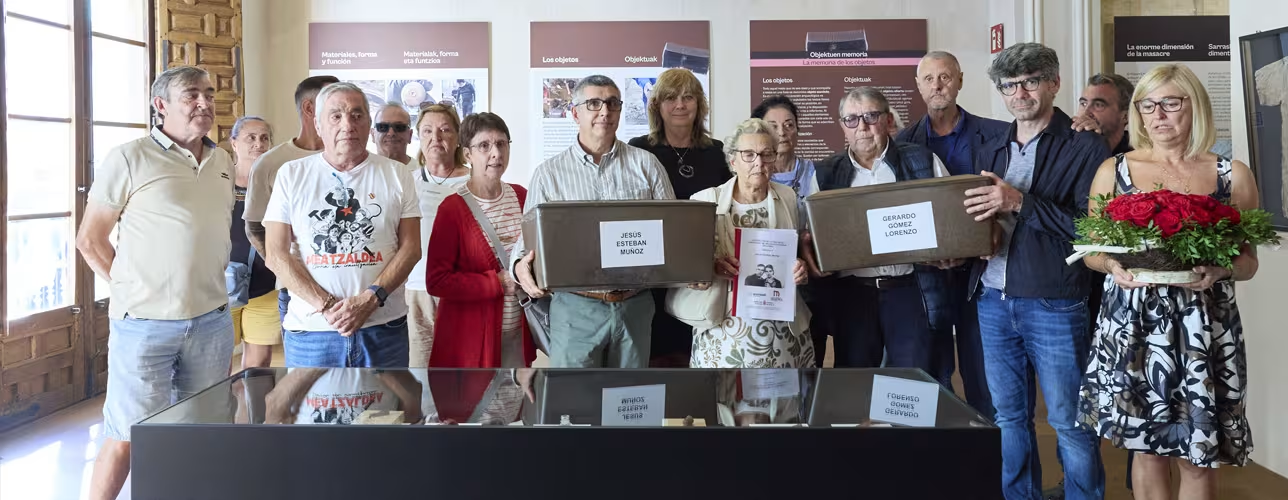
Vice President Ollo hands over the remains of Segovian native Jesús Esteban Muñoz and A Coruña native Gerardo Gómez Lorenzo to their relatives
At an event held this morning at the recently inaugurated ‘Rozalejo, Space for Memory and Coexistence’ in the historic quarter of Navarre’s capital, the Second Vice President of the Government of Navarre and Regional Minister for Memory and Coexistence, External Action and Basque Language Policy, Ana Ollo, handed over to their relatives the remains of Jesús Esteban Muñoz and Gerardo Gómez Lorenzo, whose identities were confirmed by the Regional Government’s DNA bank following the exhumations carried out in 2017 and 2018 in the graves of Urtasun and Leranotz, respectively.
A large group of relatives of both victims of repression, who travelled to Pamplona / Iruña from Galicia and Bizkaia; parliamentary representatives and members of the Technical Coordination Committee on Historical Memory; members of memorial associations; technical teams from the Aranzadi Science Society and the Nasertic laboratory; as well as representatives of the Navarre Memory Institute and the Directorate-General for Memory and Coexistence of the Government of Navarre, took part in the event.
First, members of both families spoke, expressing the mixed emotions they had experienced: the joy of identification and the pain and sorrow that relatives who spent their lives wondering about their whereabouts were unable to witness this moment, as well as the injustice they suffered. For her part, Vice President Ollo reaffirmed the Government of Navarre’s commitment to the search for missing persons through the exhumation plan and their identification through the work of the DNA bank. In this regard, Ollo stated that “in the face of the rise of denialism and the questioning of memory policies, we will always uphold rigorous work, the defence of human rights and, among them, the right of victims and society as a whole to memory; memory so that we never forget where policies of exclusion and extermination of political opponents led our societies.”
After the relatives of Jesús Esteban and Gerardo Gómez received their remains from Vice President Ollo, along with the corresponding exhumation and identification reports, attendees visited the exhibition ‘Objects of Memory’, which presents and contextualises various objects recovered during exhumations carried out across the Chartered Community of Navarre. Notably, one of the items on display is a ring engraved with the initials G.G., recovered in Leranotz alongside the body of Gerardo Gómez. They were also able to visit the exhibition ‘Shared Memories – Memoria partekatuak’, which highlights the work of the Grandmothers of Plaza de Mayo association in locating and identifying their grandsons and granddaughters.
The Escapees: Jesús Esteban and Gerardo Gómez
Jesús Esteban Muñoz, born on 22 June 1906 in Villaverde de Íscar (Segovia) and a resident of Portillo (Valladolid), entered Fort San Cristóbal on 20 January 1937, where he remained until the day of the escape, 22 May 1938. He was part of a group of escapees, three of whom were arrested in Eugi and two others in the Bardegi area, between Usetxi and the Egozkue pass. After being killed, they were taken to the cemetery of Urtasun (Esteribar), where they were buried in a mass grave. In May 2017, the five bodies buried in that grave at the cemetery were exhumed.
Gerardo Gómez Lorenzo, meanwhile, was born and lived in Bergondo (A Coruña). Born on 24 September 1916, he was single and worked as a carpenter. He entered the Fort on 14 June 1937, where he remained until the date of the escape. His body was exhumed on 22 May 2018 in Leranotz (Esteribar), on the 80th anniversary of the escape.
With the return of the remains of Jesús Esteban and Gerardo Gómez, the Government of Navarre has now handed over 53 bodies to their families following exhumation and identification. It should be noted that, to date, 444 case files concerning victims of repression have been opened. The Navarre Memory Institute reminds the families of people who disappeared after the military coup of 1936 that they can contact the public DNA bank via email at inm@navarra.es, so that further identifications and the return of remains to their families can continue, as well as the location of sites where additional graves may be found.
Source: navarra.es


