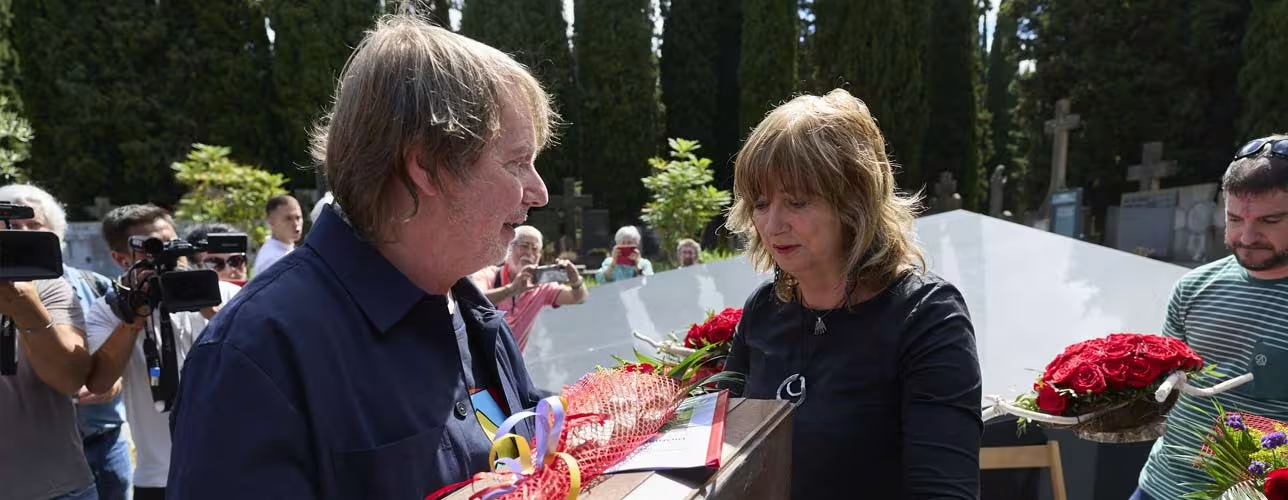
Navarra hands over to their families the remains of Ramón Bengaray Zabalza, Dionisio Gutiérrez Ijalba, and Epifanio Osoro Icobalceta.
The Second Vice-President of the Government of Navarra and Regional Minister for Memory and Coexistence, External Action and Basque, Ana Ollo, has handed over to their respective families the remains of Ramón Bengaray Zabalza and Dionisio Gutiérrez Ijalba, identified in Muniáin de Guesálaz, and those of Epifanio Osoro Icobalceta, identified in the cemetery of Berriozar. At the handover ceremony, held this Monday at the San José municipal cemetery in the Navarrese capital, those attending and accompanying the families of the three victims of repression also included the Mayor of Pamplona / Iruña, Joseba Asirón; the Ombudsman, Patxi Vera; several regional MPs; representatives of various socio-cultural and sports institutions; members of the Technical Coordination Commission on Historical Memory; and members of memory associations.
Before the burial, Vice-President Ollo reaffirmed in the speech the “Government’s commitment to the families of the victims of the Civil War and the Franco dictatorship” and highlighted that these identifications of the remains of people who suffered repression are the result of collective work, involving researchers, associations, institutions, technical teams and also the Government of Navarra, through the Navarre Institute of Memory.
Ollo also recalled that Navarra has now had 11 years of public memory policies. “Our commitment as a Government remains unchanged: with the exhumation plan, in which, despite difficulties, investigations continue whenever any information arises; with the DNA Bank, which now marks ten years of history and has just reached 50 identifications. We will not stop while there are leads to follow, relatives to find, and victims to be exhumed.”
The Vice-President also stressed that the regional government will persevere despite the risks and threats facing memory policies in many places. “We will continue working for a critical understanding of the past, as a tool to build the present and the future,” concluded Vice-President Ollo.
The respective families will take charge of the remains of Gutiérrez and Osoro, while Bengaray’s remains will rest in the municipal pantheon that houses the remains of victims of the Civil War and the Franco regime who disappeared, were exhumed and remain unidentified in graves across the Autonomous Community.
The three identified
Ramón Bengaray, born in Garralda in 1896, was the president of the Popular Front in Navarra and one of the most prominent political figures of republican Navarra. Married to Ramona Zapatero, with whom he had three children, he was a journalist and printer and a person of notable cultural and social activity in Pamplona at the time. He was a leader of Republican Left, a baritone soloist with the Orfeón Pamplonés, a founding member of “Los Irunshemes”, “Los Amigos del Arte” and the Larraina club, and a board member of Club Atlético Osasuna between 1931 and 1935. Following the coup of July 1936, he went into hiding until he was discovered and arrested on 21 August between Burutáin and Olagüe, an event that was surprisingly reported in the Navarrese press. Nothing was known about his whereabouts from that moment on.
Now, thanks to the research work of the Aranzadi Science Society in collaboration with the Navarre Institute of Memory, it has been established that he was murdered in Muniáin de Guesálaz, together with Dionisio Gutiérrez Ijalba. The latter, a native of Espinal, aged 32, was a mechanic and married to María Concepción Pérez Martínez, with whom he had one child. There are no precise records regarding his political affiliation beyond being republican and left-wing, and the fact that other members of his family were also victims of repression, such as his brother Zósimo, a customs officer, sentenced to life imprisonment and a fine of 10,000 pesetas, or his sister Juana, who had to go into exile in Oloron (Oloron-Sainte-Marie, French Béarn). The bodies of Bengaray and Gutiérrez were exhumed in July 2025, although at that time there was no clue as to their identity and the evidence pointed to other individuals. Thus, the work of the Nasertic laboratory has been key in achieving these identifications, also made possible by the fact that relatives of both had provided DNA samples for identification.
Epifanio Osoro Icobalceta, a native and resident of Durango, was 22 years old, single and worked as a mechanic. A member of the National Confederation of Labour
National Confederation of Labour (CNT), he had been sentenced by the Valladolid Court to 5 years, 10 months and 1 day of imprisonment. On 1 November 1936, Epifanio and 24 other prisoners were killed at Fort San Cristóbal, following an unclear incident in which they were accused of attempting to escape. Their bodies were transferred to the cemeteries of Artica (four prisoners) and Berriozar (the remaining 21, including Epifanio Osoro). As their deaths had been recorded, it was known that they were in these places, but not exactly where or under what conditions. In March 2022, based on a report submitted by the association Txinparta–Fort San Cristóbal to the Government of Navarra’s Exhumation Plan, the Navarre Institute of Memory, together with the technical team of the Aranzadi Science Society, carried out the exhumation of this grave and recovered the 21 bodies, of which five have already been genetically identified.
Several relatives also expressed their gratitude for the work carried out by the Navarre Institute of Memory and the Government’s DNA Bank, and to Vice-President Ana Ollo, who subsequently handed over the remains and the exhumation and identification reports to the families.
Exhumation Plan and DNA Bank of the Government of Navarra
Since 2015, when the Government of Navarra’s Exhumation Plan came into force, 163 human remains have been recovered in 38 exhumations, in addition to 133 surveys that did not result in exhumation. The public DNA Bank, now marking ten years of operation, has 439 records and has achieved 50 identifications to date. This represents a 31% success rate so far, a very significant figure compared to previous results. In this regard, advances in genetics and improvements in equipment and instruments have enabled complex achievements and provide optimism for the future.
Continuing to establish contact with more relatives remains essential, a task greatly supported by the work of researchers and memory associations. For this reason, the Navarre Institute of Memory is making a renewed appeal for public collaboration, both to locate possible graves and to find relatives of escapees and victims of repression whose genetic samples may enable further identifications. Anyone with information about these individuals, who knows of grave or burial locations, or who wishes to share testimony, can contact the Navarre Institute of Memory via email at inm@navarra.es.
Source: navarra.es


